We cannot have an exact and complete understanding of the human being if we focus only on their visible manifestation, their physical body.
The physical body of man and woman reflects everything that exists in the cosmos, but it is still too coarse, too material to manifest the splendors of the spirit that inhabits it.
Nowhere else are harmony and divine perfection better represented and embodied than in the human body.
It is up to us to work on it every day to purify and refine its substance.
The human body is a sacred temple
The physical body is nothing more for us than a vehicle, the instrument given to us so that we may live on Earth. If we observe ourselves, we will notice that we always tend to identify with our physical body: we behave as though its needs, satisfactions, or dissatisfactions were our own. When we feel dissatisfaction, we tend to respond with physical solutions. We act as if these dissatisfactions come from the physical body. So we give it food, drink, entertainment, we take it out, we provide it with all kinds of pleasures—and the physical body, once full and saturated, becomes overwhelmed and complains. In reality, very little is needed to satisfy the physical body; the demands within us come from the soul and the spirit, which constantly pray and plead: “I need purity, light, space… I need to unite with the Lord.”
We know that the physical body is perishable, corruptible, and fleeting, and yet we never stop identifying with it; we confuse ourselves with what we are not, and from this come our discomfort and discouragement. The physical body functions only because it is animated by our spirit. We must draw inspiration from this lesson: how God and Nature have arranged things, so that we may apply it to the conduct of our lives—placing everything material and temporary in the service of what is essential. Material and transient things will always have a role to play in our lives and can even be very useful, but only if we have learned to put them in service of the essential: the spirit, which is unchanging, immortal, and eternal.
As a spirit, we have not yet truly taken possession of our physical body, because we do not understand what our spirit and body represent or the work they must accomplish together. This work consists of bringing forth the divine principle within us so that it may rise as high as possible, and upon its return, purify and illuminate its dwelling—our physical body—and one day manifest through it. For the mission of the spirit is to descend and work upon matter, upon the Earth, permeating it with its qualities and splendor so that it may refine itself and transform into a magnificent garden.
This matter and this Earth are also our physical body, which we must transform, purify, and make more sensitive through the awakening and development of our subtle centers, our chakras. This too is our work: to delve deeply enough within ourselves and establish relationships with the billions of cells that make up our organism, so that they become more receptive and agree to support us on the path of light. Each cell is a living entity, a very small intelligent soul with memory, a role, and a specialty according to the organ in which it lives. Our task is to take good care of all our cells, to educate them, for we depend on them and they depend on us—we form a unity. We can do nothing without the consent of our cells; the day they stop working and contributing to the proper functioning of our organism, we can no longer breathe, feed ourselves, move, or even think.
Let us therefore set aside those who take no spiritual care of their bodies, who continually damage them by using them to satisfy their instincts and seek every pleasure. Let us turn our gaze toward those who have strengthened their will, purified their heart, enlightened their intellect, expanded their soul, and sanctified their spirit, for such beings have become true temples—their physical body itself is a temple. They can then invite the Lord to dwell within it.
The human being and their subtle bodies
True life, the only life worth living, is eternal life—that is, the life of the spirit. It alone brings us into communion with God and with the entire universe. Physical life, and even emotional and intellectual life, are only very limited aspects of life. This is what the Initiates tell us, vastly expanding the common notion of “life.” Yet when we address someone, our attention is focused on their physical aspect, their appearance, their visible identity; this is an immediate and constant reflex in human relationships. Of course, a person’s character, tastes, ideas, tendencies, and commitments are added to the physical—but is that really knowing them? Compared to the true human being described by the Initiates, the reality is that we know them only very superficially.
The human being has been prepared by the Creator to live on different planes, from the densest to the most subtle. Initiatic science and contemporary science remind us that everything is energy—energy in a more or less condensed state. In the universe, there is no energy without matter, nor matter without energy; every spiritual principle needs, in order to act, a material support. Matter therefore exists in an infinite number of states, and the human being follows this universal law as well, since they are composed of a physical body and increasingly subtle bodies up to the spirit.
Our physical body is inhabited by an invisible and subtle principle generally called the soul (from the Latin anima: vital breath), without which we would not be alive. The physical body is matter—it is the support—and the soul is energy, the living principle that animates it. Let us take the metaphor of a perfume bottle. The bottle is the body; the liquid is the soul, which preserves and nourishes the fragrance; and the fragrance is the spirit. Like a perfume, the spirit is very volatile; it seeks to regain its freedom and return to the Source. To keep it on Earth, it must be given nourishment—that is, the soul—and then enclosed in a body.
The physical body allows us to act, and what we call the heart and the intellect are also, though more subtle, material instruments called “bodies” by Hindu Masters. The heart is the seat of our emotions, feelings, and desires—it constitutes the astral body—and the intellect, through which we can think and study, constitutes the mental body.
Thus we have our earthly self (our so-called lower nature), which is a trinity that thinks, feels, and acts, but in a human, imperfect, and often limited way; and a heavenly trinity (our so-called higher nature), which thinks, feels, and acts in a selfless and sublime way, and waits for us to identify with it, since it too is part of us.
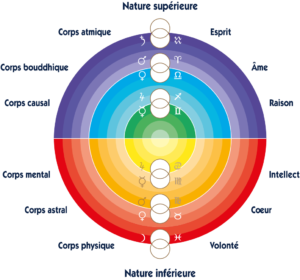 To the physical body, the seat of our actions, of instinctive force, of ordinary will, there corresponds in its higher principle the divine will, the omnipotence of the atmic body—which is also the seat of truth, for truth is the consequence, the symbolic child of our feelings and our thoughts.
The astral body, the seat of our feelings, our selfishness, and our insatiable desires, corresponds—when sublimated—to the divine love of the buddhic body.
To the mental body, the seat of our intellect and our error-prone thoughts, corresponds at the highest level divine wisdom, discernment, and mastery of the causal body.
Thus, one can say that the human being is made up of a system of six bodies—three lower and three higher—which are destined one day to unite and create fullness within us. However, this union can only take place if we have first begun an inner work to balance, heal, purify, and master our lower nature, and to draw forth our higher nature from the depths of our being. Who has not had the intuition to understand and observe that life’s experiences—the sufferings or difficulties that trouble us for a time—are ultimately those that help us move more quickly along our path of spiritual evolution?
What is the role and place of our soul in this work of spiritual evolution? The Initiates tell us that the soul is the instrument through which the spirit acts on the physical plane. The spirit has no direct hold over the physical body; it cannot shape or organize it. All the elements that make up the body’s richness can only be used by the spirit through an intermediary: the soul. Thus, we have the body, the soul, and the spirit—the universal structure of creation found everywhere.
Indeed, consider the example of the egg, a symbol of great importance in initiatory tradition. The yolk at the center corresponds to the spirit; the white surrounding it corresponds to the soul; and the shell on the outside corresponds to the body. The same structure exists in a cell: the nucleus at the center, the cytoplasm around it, and the membrane on the outside. In a fruit, we find the same pattern: at the center, the seed containing the germ of life—the spirit; it is surrounded by flesh—the soul; and the flesh is protected by the skin, which represents the physical body. In human beings, this same process appears in the form of truth, love, and wisdom. Truth is the seed we must plant—the spirit; love represents the flesh, the part of the fruit we eat—it is the life of the soul; wisdom is what limits and protects—the physical body.
Universal Intelligence has endowed the human being with subtle centers that allow communication with spiritual realms. It is important to become aware of them while also adopting ways of living that will enable us to develop them. The life we have received—it is up to us to strengthen it, to make it more beautiful, more refined, and more spiritual.
The human being in search of their divinity
We have seen that Universal Intelligence has endowed human beings with subtle centers that allow them to communicate with spiritual realms. Human beings are made up of a physical body, but also of several invisible bodies such as the mental body, the seat of the intellect. Obviously, the intellect is an excellent means of knowledge, but it is nevertheless limited, because it judges and draws conclusions based on appearances and on the partial view it has of things. It cannot grasp the subtle and intangible elements that surround us.
If we meet someone, for example, we cannot immediately know who they are unless we spend some time with them. The only way to know a being in their entirety instantly is to develop intuition, which is a manifestation of the spirit. Intuition does not need any external elements to make a judgment: it penetrates instantly to the heart of beings and things and makes its assessment at once, without ever being mistaken.
Intuition is at once both understanding and sensation; it possesses the true intelligence of life. It is connected to higher planes, to the causal body (see the previous chapter), the seat of reason, discernment, and divine wisdom.
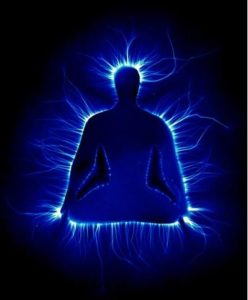
When we connect to higher planes, to our divine nature, it is upon our aura that we act. If we want to be healthy, to live in peace, love, and joy, or to attract other blessings, one of the best and safest methods is the practice of virtues. That is where the work on the aura lies.
The aura is our spiritual skin, our true garment—a garment of light that surrounds every living creature. Kirlian photography has shown that every living being is enveloped by an electromagnetic energy field. In human beings, the aura is made of a subtle substance far richer than just the electromagnetic aura: it also includes a quintessence that represents everything we feel and experience deep within ourselves.
It is a kind of fire that protects us from negative influences, provided it is enlivened by our wisdom to make it radiant, by the strength of our character to make it powerful, and by a pure life to make it clear and transparent. Each virtue we develop gives a new quality to our aura; it becomes a kind of passport that allows us to enter certain regions of the invisible world, through the colors it contains.
If we possess the color blue, we will be admitted into the realms of music or religion; the color red into those where we draw the very essence of vitality; the golden yellow color into the libraries of nature. By entering these different regions, we come into contact with the spirits that correspond to them: they will receive us and come to our aid.
Another particular quality of the aura is its ability to infuse our words with its subtle substance when we speak in front of others. The power of speech does not come from the word itself, but from the energy, the quintessence, the creative light with which it is imbued. It is futile to try to persuade anyone of the need to be generous, honest, just, or kind if we do not deeply live what we say, if the qualities of our aura are not in harmony with our words and our arguments.
The human being is a tiny point, an atom of light. But at the same time, he is immensely vast; he encompasses the entire universe. It is said that God created us in His image, and since God has the universe as His body, we are therefore in the image of the universe, an expression of harmony and perfection. This harmony and perfection are nowhere better represented than in the human body. Nothing, then, can prevent us from turning inward each day, seeking the divine center within ourselves—this center that is like a sun, a nucleus around which all elements find their place and the path they must follow without collision. All our cells, all the particles of our being that do not vibrate in harmony, are drawn back toward this center around which they must gravitate. This is how we will gradually introduce order, health, balance, harmony, and beauty within ourselves.
This work of identifying with our higher Self is long and requires discernment and perseverance. We may lose what does not truly belong to us—that is, what is not yet fully part of us. At one moment we have faith, and then we doubt; at one moment we have light, and then we are in darkness; at one moment we love, and then we no longer love. For these to truly belong to us, we must become faith, love, and light ourselves. On the material plane, we can lose many things that belong to us, but what we are—what is blended with us, fused with us—we cannot lose. To fuse implies a law, the law of resonance: it means identifying, vibrating at the same wavelength as a virtue, an ideal, a quality, or a being, which allows us to know it. To merge with the divine spirit, with its omnipotence, to identify with the light, to possess a heart as pure as crystal—is this not our intimate and silent spiritual quest?
The physical body, its inner life
The cells of our body form within us an immense people with whom we can enter into relationship and whom we have the mission to tame and educate. Cells are the dwelling places of tiny souls, of small intelligent entities, each of which has been entrusted with a specific activity. For a cell is not a mere particle of matter in the human organism; it behaves like a worker conscious of the task it must accomplish in the part of the body where it is located, and it is upon its work that the proper functioning of the whole depends. Cells are not identical to one another: a cell of the heart is not a cell of the stomach. Each retains its individuality because it does not perform the same functions. But their affinities and connections with one another create that state of harmony and unity which we call health.
This harmony and unity is the finest example of selfless love: each organ works for the well-being of the entire body and not only for its own well-being. Once again, the human body serves as our model and teaches us with what intelligence and perfection we have been created. Between the infinitely small that we are and the infinitely vast universe that surrounds us, there exists a multitude of correspondences; all the organs of our physical body, as well as those of our psychic and spiritual bodies, are in affinity with regions of the cosmos.
However, this inner peace, this perfect agreement with our cells—the unity we seek—will require great effort, much willpower, and above all much love. We will have to face uprisings, revolts, and conflicting wills. Often, upon discovering a spiritual truth, we become enthusiastic and sincerely wish to live in harmony with it. But it happens that this enthusiasm quickly fades. Why? Because not all our cells are convinced—only a few have been touched. The others turn a deaf ear and refuse to be disturbed in their habits; they have their own will, they resist, and since they are more numerous, they win the contest.
Through thought, through our strength, our patience, and our love, we can connect with our inner people, captivate them, and lead them so that they listen to us and place themselves at our service. By striving to master, purify, and enrich our inner life, we act not only upon the material particles of our cells but upon their memory. Everything is recorded in them: the slightest of our impulses, thoughts, and attitudes is noted and will one day be reproduced. If we transgress a law, for example, we will feel tensions, disturbances, and discomfort without understanding why. Cells are like children who must be educated, and for cells as for children, the only true education is example.
In a previous section, we saw that water is that precious, indispensable element, the vital fluid that flows through the depths of the earth and nourishes all kingdoms of nature. By analogy, this “water” that circulates in our arteries and veins like an elixir of life is our blood. Blood is chemically composed of identical elements in all human beings, yet we do not all have the same blood. The quality of our blood depends on the life we lead, the purity of the air we breathe, the food we consume, the qualities and virtues we have developed, and our level of evolution.
Blood is an infinitely precious liquid; one who loses their blood also loses life. As long as it circulates within the body, it is protected as if in a closed vessel. But if it escapes from the body for one reason or another, like any liquid it evaporates and its ethereal particles disperse into space. Yet these particles are alive; they retain something of those elements that make blood the bearer of life. Since the most ancient times, it has been known that these emanations from blood nourish entities of the invisible world; priests used the blood of sacrificial victims offered to the gods to invoke celestial or dark entities.
In our physical body, the heart represents the sun; it has the same functions and the same tireless activity. Without ceasing, while other organs relax their activity somewhat, it continues its work to help, support, and sustain the entire body. Blood represents the life that circulates in the universe, and within us it is what most closely resembles light. Thus we must have immense respect for our own blood, which is condensed light, condensed divine life. And just as our blood returns to the heart, our life too returns to the heart of the universe—the Creator.